 English
  Spanish
  German
  Russian
  Italian
  French
From the soft matte surface of a smartphone shell to the smooth satin shine of aircraft parts, bead blasting quietly shapes how modern products look and feel. It gives both beauty and consistency, making parts appear clean, smooth, and even without losing precision.
In manufacturing today, customers expect both tight tolerances and perfect appearance. Bead blasting has become a trusted finishing step. It connects machining and coating, improves surface quality for metals and plastics, and prepares parts for anodizing, painting, or assembly.
What Is a Bead Blast Finish?
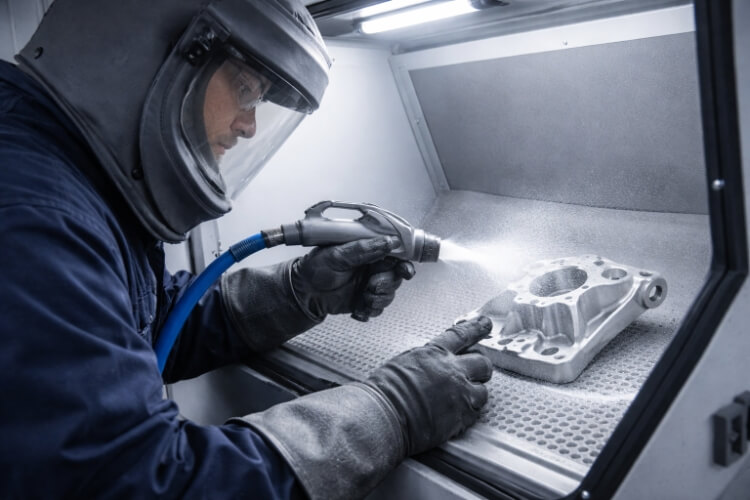
A bead blast finish is made by shooting small round particles — called beads — onto a surface using controlled air pressure. These beads can be made of glass, ceramic, stainless steel, or plastic, depending on the use. Instead of cutting or removing much material, each bead hit slightly evens out the surface, creating a smooth satin or matte look.
The process is mechanical, not chemical. It doesn’t change the material’s structure or shape. The size change is very small — usually 2–5 µm — so even precision CNC parts keep their original accuracy. That’s why engineers often use bead blasting as a final touch or as a step before coating.
How It Works?
Bead blasting works through micro plastic deformation. When each round bead hits the surface, it flattens small peaks and presses down valleys. This creates a smoother, even surface that scatters light softly, giving it a glare-free finish.
The surface roughness (Ra) usually ranges from 0.8 µm to 3.2 µm, depending on bead size, hardness, and pressure.
- Small glass beads (50–100 µm) give a fine satin finish with Ra ≈ 0.8–1.6 µm.
- Larger ceramic beads (200–400 µm) give a deeper matte finish with Ra ≈ 2.0–3.2 µm.
According to ISO 8503-4, surface quality can be measured using surface comparators or profilometers. This ensures that what looks good also meets technical standards.
Bead Blasting vs. Sandblasting
Both processes use air to shoot particles, but their results are quite different:
| Aspect | Bead Blasting | Sandblasting |
| Media shape | Round (glass, ceramic) | Angular (sand, grit) |
| Action | Gentle peening, smoothing | Strong cutting, removal |
| Surface result | Satin or matte, even | Rough, dull, directional |
| Best for | Finishing and prep | Heavy cleaning or rust removal |
Bead blasting’s round impact causes less surface stress and avoids tiny cracks that sandblasting can cause. This is important for aluminum housings, titanium fasteners, and thin stainless-steel panels, where part strength and accuracy must be protected.
How the Bead Blasting Process Works?
From air pressure to bead size, every variable shapes the outcome. A closer look at the process reveals how equipment setup and parameters create repeatable, quality finishes.

Equipment Setup
A professional bead-blasting setup usually includes:
- Air Compressor — Provides air pressure around 0.4–0.7 MPa (≈ 60–100 psi).
- Blasting Cabinet or Chamber — Holds the operation and prevents dust.
- Nozzle and Gun Assembly — Controls the bead direction and angle.
- Media Reclaimer and Dust Collector — Separates reusable beads and keeps the workspace clear.
- Lighting & Control Panel — Gives consistent light and allows pressure adjustment for stable results.
Modern systems often include digital sensors and media sorting devices to keep performance steady across batches.
Process Parameters
The final surface depends on five main settings:
| Parameter | Typical Range | Effect |
| Air pressure | 0.45–0.7 MPa | Higher = rougher finish; lower = smoother |
| Nozzle distance | 100–200 mm | Controls coverage and heat |
| Angle of impact | 60°–80° | Gives even reflection and avoids marks |
| Media flow rate | 0.2–0.4 kg/min | Affects consistency |
| Cycle time | 30 s – 3 min | Controls texture depth and brightness |
Engineers usually test a few samples first to find the best setup. For example, 6061-T6 aluminum looks best at around 0.5 MPa, with a 150 mm nozzle distance and 100 µm glass beads.
Media Types and Selection
Picking the right bead type is key to getting the right balance between look, strength, and cost.
| Media Type | Hardness (Mohs) | Reuse Times | Common Use |
| Glass beads | ~6 | 15–25 | Aluminum, stainless steel, anodizing prep |
| Ceramic beads | ~7.5 | 30–40 | Titanium, aerospace, strong alloys |
| Plastic beads | ~3 | 5–10 | Composites, soft metals, paint removal |
| Stainless-steel beads | ~8 | 40+ | Medical, food-grade, clean finishes |
Surface Characteristics and Finish Quality
The science behind surface texture goes far beyond looks. These factors determine how light reflects, coatings adhere, and materials perform under real-world conditions.
Texture and Gloss Control
The signature of a bead-blasted surface is its satin or matte appearance. This look comes from tiny dimples that scatter light evenly in all directions. The result is a soft, non-glare finish that works well for both industrial housings and consumer products.
Three main variables control this texture:
| Variable | Control Range | Effect on Finish |
| Bead size | 50–400 µm | Small = fine satin, large = deeper matte |
| Air pressure | 0.45–0.7 MPa | Lower = smoother gloss, higher = rougher tone |
| Bead hardness | 5–8 Mohs | Softer = gentle surface, harder = sharper texture |
To check consistency, engineers use a 60° gloss meter as per ASTM D523 standards.
- 0–10 gloss units (GU): matte
- 10–30 GU: satin
- 30–70 GU: semi-gloss
For high-end aluminum parts, an ideal gloss level is 10–15 GU. This creates a “soft metallic” look that pairs well with anodizing or powder coating.
Surface Roughness (Ra) and Its Role
Surface roughness shows how smooth or coarse a surface is. Standards like ISO 4287 and ASTM D7127 define Ra as the average height difference between peaks and valleys on the surface. In bead blasting, Ra values usually fall between 0.8–3.2 µm, depending on the job.
| Finish Type | Ra (µm) | Common Use |
| Fine (satin) | 0.8–1.6 | Decorative parts, anodized finishes |
| Medium (matte) | 2.0–3.2 | Machine housings, panels |
| Coarse | >3.2 | Cleaning or oxide removal |
For anodized aluminum, an Ra around 1.2 µm gives even color and strong coating adhesion. For stainless-steel enclosures, a rougher Ra near 2.5 µm reduces glare and hides fingerprints under bright light.
Dimensional Impact and Microstructural Stability
Bead blasting removes very little material — usually less than 5 µm per side. However, the repeated impacts create small compressive stresses on the surface. These stresses can improve a metal’s fatigue resistance by 10–20 %, as studies on 304 stainless steel have shown.
Still, care is needed when working with tight tolerances. For parts with fits under ±0.01 mm, engineers use masks or fixtures to protect precise areas. Common solutions include laser-cut silicone masks or 3D-printed covers to shield threads, seals, or bearing seats.
This level of protection is vital for parts where gaskets, lenses, or bearings must fit perfectly — even a few microns of variation can affect sealing or alignment.

Material Compatibility
Different materials react differently to bead blasting. Factors like hardness, flexibility, and oxide layers affect how each material responds.
Metals
Aluminum (6061, 5052, 7075):
Aluminum is one of the most common materials for bead blasting. Using 100 µm glass beads at ~0.5 MPa gives a smooth satin tone suitable for anodizing or powder coating. The process also cleans away cutting oil and light oxidation.
Stainless Steel (304, 316L):
Because it’s harder, stainless steel requires ceramic or steel beads at 0.6–0.7 MPa. The result is a fine gray surface with Ra around 2.5 µm, offering better light diffusion and cleanability. After blasting, passivation helps restore corrosion resistance.
Titanium Alloys (Ti-6Al-4V):
Titanium reacts well to bead blasting, especially for aerospace or medical uses. It creates an even oxide layer and uniform matte texture. According to ASTM F86, blasting must be tightly controlled for surgical components to avoid contamination.
Brass and Copper:
These metals are soft, so they need low pressure (≤0.4 MPa) and small glass or plastic beads. The result is a warm satin look, often used for decorative or architectural parts.
Plastics and Composites
Bead blasting also works for engineering plastics such as polycarbonate, PEEK, and glass-fiber composites (GFRP). With plastic or acrylic beads at low pressure (<0.3 MPa), it adds light texture or improves paint adhesion. The goal is not to remove material but to improve surface bonding and reduce gloss.
Surface Preparation for Coatings
Bead blasting is an excellent pre-treatment step before coating or plating. The slightly roughened surface increases surface energy and improves adhesion.
Tests show that bead-blasted aluminum can improve powder-coating adhesion by 15–25 %, based on ASTM D3359 cross-cut tests. In anodizing, it helps form an even oxide layer, leading to uniform color and shine.
Applications Across Industries
Bead blasting supports everything from sleek consumer products to aerospace-grade components. Each industry applies it differently to balance appearance, hygiene, and durability.
Consumer Electronics
The smooth satin texture found on many smartphones, laptops, and tablets is usually achieved through fine glass bead blasting before anodizing. This creates a soft metallic look that hides machining lines and fingerprints.
For example, a CNC-machined 6061 aluminum unibody blasted with 100 µm glass beads at 0.5 MPa often reaches Ra ≈ 1.2 µm. After anodizing, it gains a uniform color and pleasant feel.
Aerospace and Automotive
In the aerospace and automotive sectors, bead blasting focuses more on performance than looks. It helps remove residues, reduce stress, and restore surface balance after machining or heat treatment. The gentle peening action adds compressive stress to the surface, increasing fatigue strength by 10–20 %.
Typical applications include titanium brackets, turbine blades, and aluminum engine parts. Many aerospace facilities use robotic blasting arms with automatic pressure control to maintain accuracy within ±0.02 MPa, as required by AS9100 quality standards.
Medical and Food Equipment
In medical and food industries, bead blasting helps create clean, safe, and glare-free surfaces. In 316L stainless-steel surgical tools, implants, and food-processing equipment, the matte finish prevents reflections and reduces areas where bacteria might collect.
Surfaces treated with 100–150 µm glass beads, followed by citric passivation, meet ISO 10993-1 standards for biocompatibility and hygiene. These parts can withstand repeated sterilization while keeping their smooth, professional appearance.

Design and Engineering Considerations
Effective bead blasting begins in the design phase. Setting clear goals and parameters ensures every part meets visual and dimensional expectations.
Selecting Parameters by Function
Every bead blasting project starts with a clear goal — whether for decoration, cleaning, or surface preparation. The table below gives a guide for parameter selection:
| Objective | Typical Bead Size | Air Pressure | Target Ra | Notes |
| Aesthetic satin finish | 70–120 µm | 0.45–0.6 MPa | 0.8–1.6 µm | Common for aluminum housings |
| Cleaning / oxide removal | 120–250 µm | 0.55–0.7 MPa | 2.0–3.2 µm | Used for steel or cast parts |
| Pre-coating adhesion | 150–250 µm | 0.6–0.7 MPa | 2.5–3.5 µm | Best for painting or powder coating prep |
Engineers usually confirm settings by testing a sample coupon under real production conditions. Many factories store these samples in a process reference library to keep quality consistent in future batches.
Critical Zones and Masking
Not every part surface should be blasted. Areas like seal faces, threaded holes, bearing seats, and optical windows need protection. Proper masking saves time and prevents quality issues.
Common protection methods include:
- Silicone plugs for threaded features
- Durable adhesive tapes rated for high-pressure blasting
- 3D-printed shields designed for complex shapes
Robotic systems now rotate parts automatically during blasting to avoid overspray and improve coverage. A good masking plan can cut rework or scrap rates by over 30 % in production.
Common Mistakes and Troubleshooting
Even minor errors can cause poor or inconsistent finishes. Below are typical problems and quick fixes:
| Problem | Cause | Fix |
| Patchy texture | Clogged nozzle or uneven bead flow | Clean filters and check air pressure |
| Overly matte surface | Too high pressure or worn beads | Lower pressure and replace beads regularly |
| Embedded debris | Contaminated or damp media | Use clean, dry beads and filtered air |
| Dimensional change | Too long exposure on critical zones | Reduce angle or apply masking |
Regular maintenance is key to stable performance. Cleaning filters and replacing media every 8–10 operating hours helps maintain finish quality and extend equipment life.
Conclusion
Bead blasting plays a key role in modern surface finishing. It connects machining with final aesthetics—making parts smoother, more uniform, and visually refined while keeping precise dimensions intact.
In today’s market, where appearance, performance, and quality must work together, bead blasting stands out as a reliable method that combines engineering precision with visual excellence. It delivers consistent, measurable results that meet both technical and design needs.
If you want to achieve a stable satin finish on aluminum, stainless steel, or titanium parts, our engineering team can help. We specialize in custom bead blasting setups and surface optimization. Send us your drawings or process requirements, and we’ll recommend the best parameters and confirm results through Ra and gloss testing.
FAQs
What’s the main difference between bead blasting and shot peening?
Bead blasting focuses on surface texture and appearance using fine beads at medium pressure. Shot peening, on the other hand, uses heavier metal shots at higher speed to create deep compressive stress, improving fatigue strength. Bead blasting is mainly cosmetic and preparatory, while shot peening is structural.
How does bead size affect the surface finish?
Smaller beads (50–100 µm) create smoother satin finishes with Ra ≈ 0.8–1.6 µm. Larger beads (200–400 µm) make rougher matte textures with Ra ≈ 2.5–3.5 µm. The right size depends on the balance you want between cleaning power and surface appearance.
Can bead blasting be done before anodizing or powder coating?
Yes. It’s one of the best preparation steps. The fine, uniform texture improves coating adhesion and helps the final color appear more even after anodizing or painting.
Does bead blasting reduce part strength?
No. When parameters are controlled, bead blasting removes almost no material and often adds light compressive stress to the surface. For metals like stainless steel and titanium, this can actually increase fatigue resistance slightly.
How can finish consistency be verified?
Use a profilometer to measure surface roughness (Ra, Rz) following ISO 4287, and a 60° gloss meter (ASTM D523) to check gloss levels. In production, each batch is compared to a reference coupon to ensure the same appearance and surface quality.